Request a demo
11 AI agents

The agents that build, run and diagnose your tests

Each InsightTestBench agent has one bounded job and leaves its work where your team can read it. Agents prepare plans, cases, runs and diagnoses; your QA team and developers decide what ships.

The principle

Agents prepare. Your team decides.

An agent reads the page, writes the case, runs it and explains the failure. Promoting a finding into the suite, merging a fix and holding the credentials stay with people and with your own systems.

  • Plain bundles. Every agent is an InsightWorker bundle of YAML and a manifest you can read, fork and extend.
  • Evidence first. Each verdict points at the case spec, the step log, the error and a screenshot.
  • On your infrastructure. Agents run on your workers, with your model keys and your secrets store.
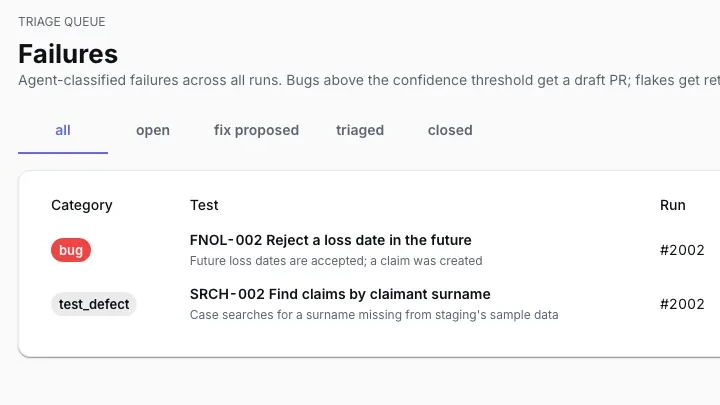
Failures · triage queue · demo data
Triage queue with agent-classified failures: a bug at 82 percent confidence and a test defect at 64 percent
Agent-classified failures. Bugs above the confidence threshold get a draft PR; flakes get retried. Made-up example data.
The agent catalogue

What each agent prepares, and where you decide

Grouped by the four stages of the QA loop. Names are the bundle names the bench dispatches.

Stage 1 · 3 agents

Bootstrap: from a brief to a project

A paragraph about the app becomes a project with a feature tree, personas, sample data and plans.

Test Suite Bootstrap

test-suite-bootstrap

PreparesCrawls the app, lists its user-facing features, derives personas and sample-data needs, and writes one plan per feature plus a regression suite that combines them, with responsive and UX-audit plans.

Works fromYour brief, the URL, crawl and login options, the maximum number of features and cases per feature.

You decideThe QA manager reviews the feature tree and plans on the project page, and can refine them with another brief.

Test Plan Generator

test-plan-generator

PreparesA structured plan from a feature brief: outline, scenarios, and steps with expected results, as readable Markdown and as cases the executor runs.

Works fromA feature brief and the app under test.

You decideWhich plans join the suite and which cases stay.

Sample Data Generator

sample-data-generator

PreparesSynthetic sample files for a project (claims, resumes, transactions, reviews and more), realistic enough to drive a case, with no personal data.

Works fromThe project and the kind of file the cases need.

You decideWhat goes into the sample-data folder the cases upload.

Stage 2 · 3 agents

Ground: cases that match the real page

Cases reference labels and selectors that exist, and end with explicit assertions.

Vision Case Generator

vision-case-generator

PreparesCases for a feature written from a real screenshot of its page and structured DOM observations, using only elements it can see and ending in assert_* verbs.

Works fromThe feature page, its screenshot and DOM extract.

You decideAppend the new cases or replace the old ones, so hand-tuned cases are kept.

Form Profile Generator

form-profile-generator

PreparesFor a form: one happy profile, the negative profiles and one profile per dropdown option, each with its expected result.

Works fromThe form specification read from the live page.

You decideWhich profiles to keep in the sweep.

Regression Builder

regression-builder

PreparesAPI-shaped versions of UI cases, grounded in an OpenAPI hint or an example request; cases with no API equivalent are marked for the UI driver.

Works fromUI cases and, optionally, an OpenAPI document.

You decideWhich API cases replace slower UI runs.

Stage 3 · 3 agents

Run and explore

Runs that are comparable night after night, and exploration that finds what nobody planned.

Test Executor

test-executor

PreparesRuns each case by kind (UI through Playwright, API through HTTP, data through a query) in one browser session with one login, recording pass or fail, assertion details, latency and screenshots.

Works fromA plan, a persona and an environment.

You decideWhen it runs: on demand, per persona, or on a schedule.

Agentic Explorer

agentic-explorer

PreparesDrives a live site in a persistent browser (snapshot, decide, act, observe), records each defect with repro steps and evidence, and proposes regression cases from the findings, within a hard cap on browser actions.

Works fromA feature URL and a mission.

You decideWhich findings a person promotes into a plan.

Exploration Chat Agent

exploration-chat-agent

PreparesSmall, surgical changes from a chat on the project page: a note, a new case, an edited or deleted case, or a captured page state, with a short reply.

Works fromThe exploration guide, feature tree, plans and the chat so far.

You decideEvery change is asked for in the chat, by a person.
Stage 4 · 2 agents

Diagnose and fix

A red run turns into a verdict and, for real bugs, a pull request to review.

Failure RCA

failure-rca

PreparesFor one failed case: a one or two sentence likely cause, a suggested fix and a confidence, classed as test_design, product_bug or environmental.

Works fromThe case spec, the step log, the error and the page observations.

You decideWhether to fix the test, fix the app or check the environment.

Bug-Fix Engineer

bug-fix-engineer

PreparesFinds the likely faulty code for a classified bug, proposes a fix, pushes it on a feature branch and opens a pull request.

Works fromThe failure record, the source repository and its default branch.

You decideBelow the confidence threshold, or on a protected branch, the PR opens as a draft; a developer reviews and merges.

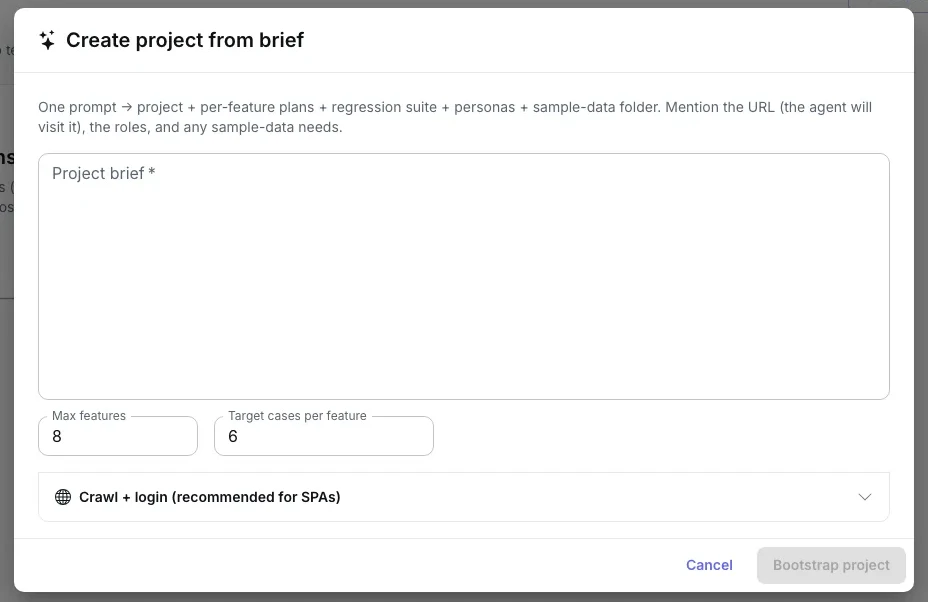
Create project from brief · demo data
The Create project from brief dialog: a project brief field, maximum features, target cases per feature and the crawl-and-login option
Where it starts

One prompt, then the agents take turns

One brief produces a project, per-feature plans, a regression suite, personas and a sample-data folder. Mention the URL, the roles and the sample data you need; choose how many features and cases per feature, and whether the agent should crawl and log in.

From there the executor runs the suite on a schedule, the RCA agent explains each failure, and the bug-fix agent opens a pull request for the ones that are real bugs.

From a brief to a project